Personal Rig Update
I’ve made some updates to my personal rig over the last couple years that were focused on simplifying the build as well as making it easier to work on and transport. The net result is a resounding success!
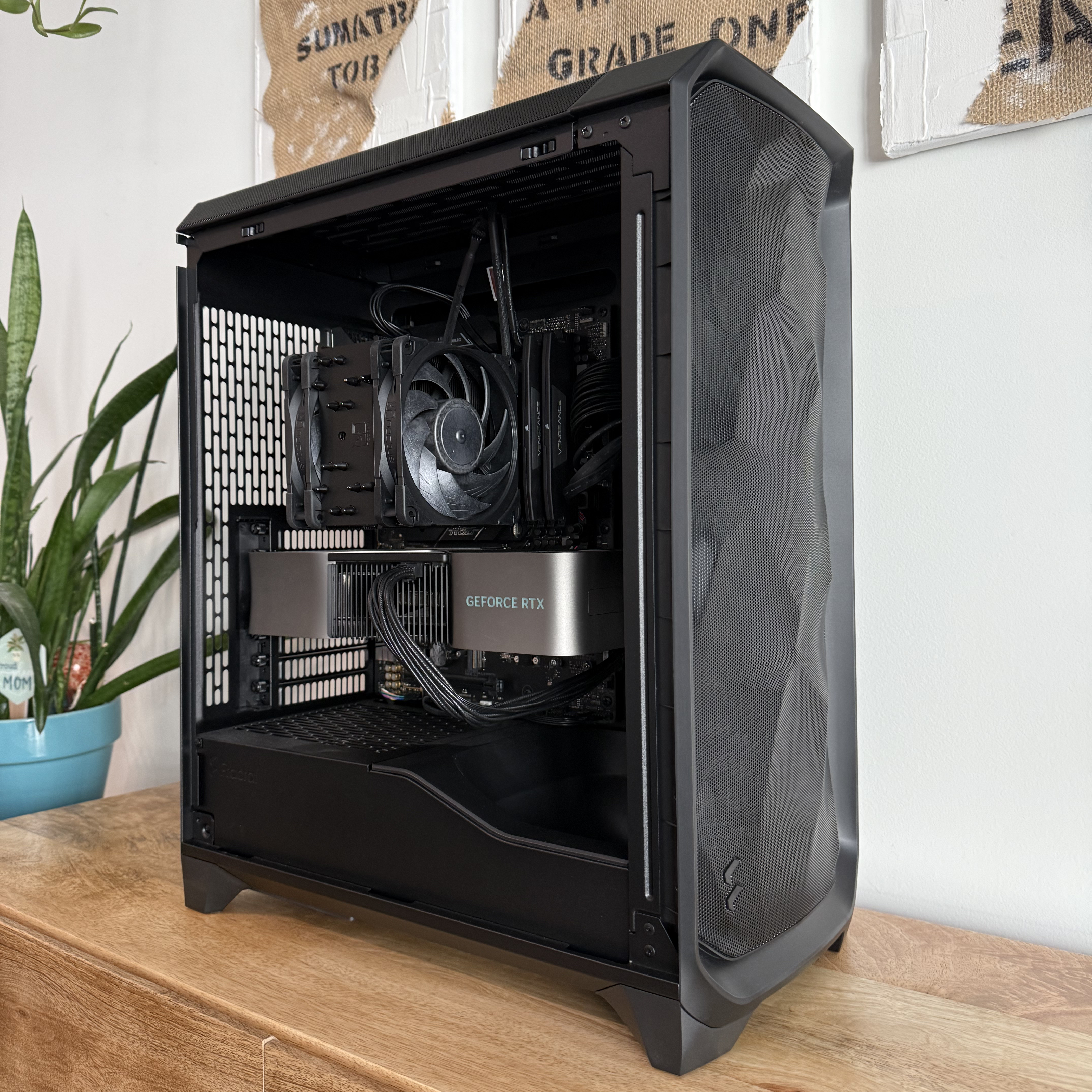
This is it: the updated build in the Fractal Design Meshify 3 (non-RGB). The build retains the Nvidia RTX 4090 GPU (acquired April 2023) and AMD Ryzen 7 7700X CPU (acquired November 2022) featured in my last update. It’s been in service since June 2025, but enough time has passed to talk about my experience with it.
There was little wrong with the existing build. It performed extremely well and the Lian Li O11D EVO XL case was well built, sturdy and easy to work in. However, the sheer weight and size for transporation, upgrades and maintenance was overkill for what I needed. I not only wanted to downsize for ease of use, but I also wanted to fit my desktop computer back onto my desk and off of the floor.
I started experimenting with smaller cases and reducing the total number of fans. The goal was to downsize while achieving a similar noise profile with similar temps.
Lian Li and Dan Cases collaborated on an excellent mATX case that caught my eye: the A3-mATX. I picked up the wood panel version in early 2025 due to the front panel featuring openings in between the wood pieces. In contast, the base version features a solid front panel. This allowed me to face the PSU fan outwards to separate its airflow from the interior.
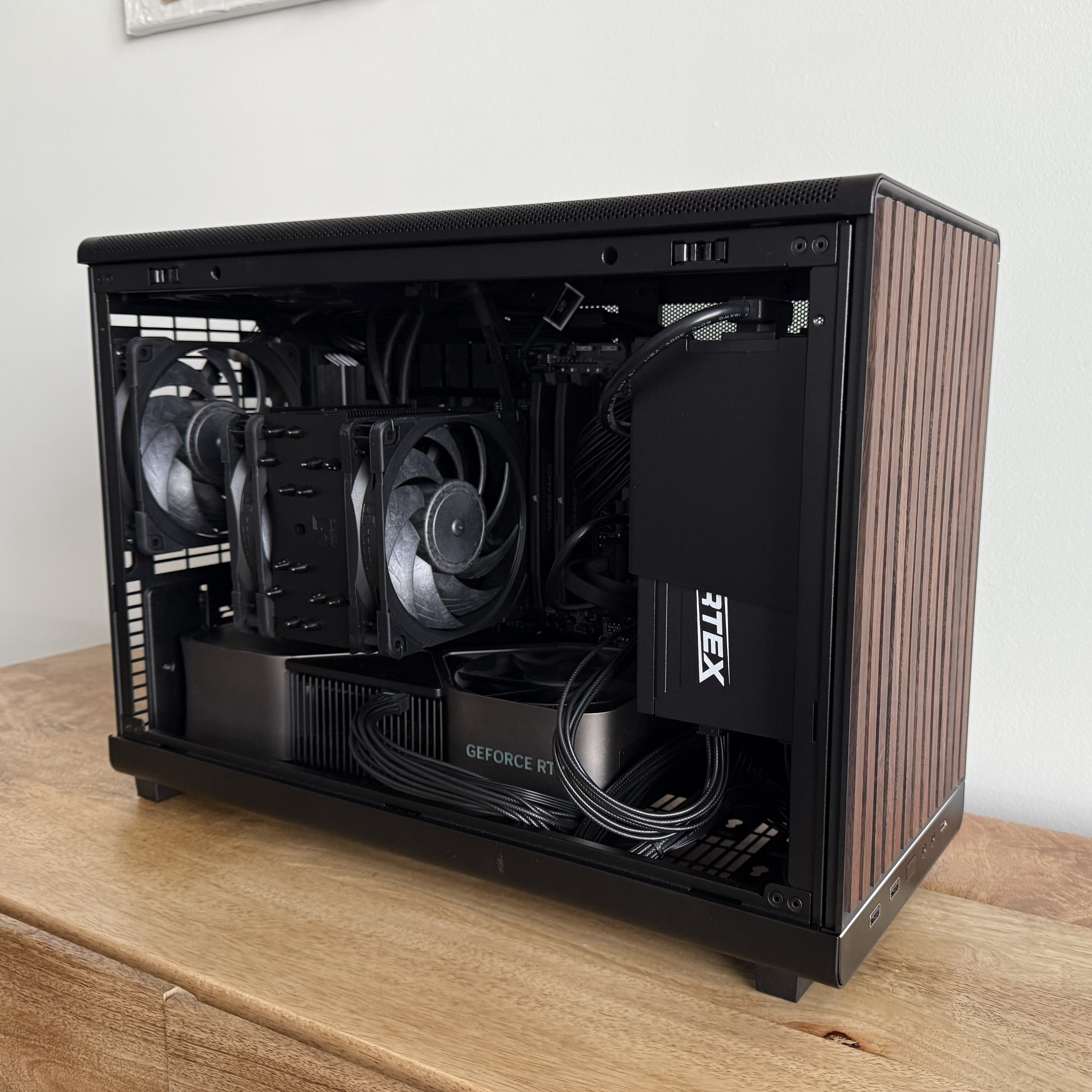
The problem with this build was how noisy it was. That was true for both the builds using the 360mm AIO I brought over and the Noctua U12A air cooler that I eventually switched to. I was getting used to having my desktop on my desk again with fans spinning near my ears and the all-mesh enclosure didn’t help. Fan Control was an excellent utility to help dial everything in for both noise reducation and performance, but I decided that this form factor might not have been for me at that time. I had always been interested in both SFF and mATX form factors, but had never taken the jump because the uncompromising nature of custom desktop computers had always been a key selling point to me.
That being said, I’m very happy I tried the A3-mATX. I’d happily revisit this form factor with a bottom-up approach to cooling (i.e. buying all the parts with a build in mind) or with lower power parts. There are exciting cases in both the SFF and mATX spaces, like the Ncase M3 and Fractal Design Terra, that could make for great builds.
Fortunately, soon after this experiment, Fractal Design released the Meshify 3 series of cases. I had been eyeing the “wind tunnel” sector of PC cases for the past couple of years in particular. Dual chamber cases like the Lian Li 011D series and Phanteks NV series are awesome, but the front-to-back airflow cases lend themselves well to simple builds featuring a small number of fans with air-cooled components.
There were a lot of great cases featured at trade shows, including Computex and CES. Some standouts were the HAVN BF 360, the Antec Flux Pro, the Lian Li Lancool 217 and the Fractal Design North (and North XL). However, the release of the Fractal Design Meshify 3 caught my eye in particular. I used their Meshify C case in a 2019 build and loved it, so checking out the next iteration in the tried-and-true, plain black box, “wind tunnel” series was a natural step to take.
The build plan turned out to be much simpler than my last build plan. In fact, I used no additional fans than what came with the case and CPU cooler.
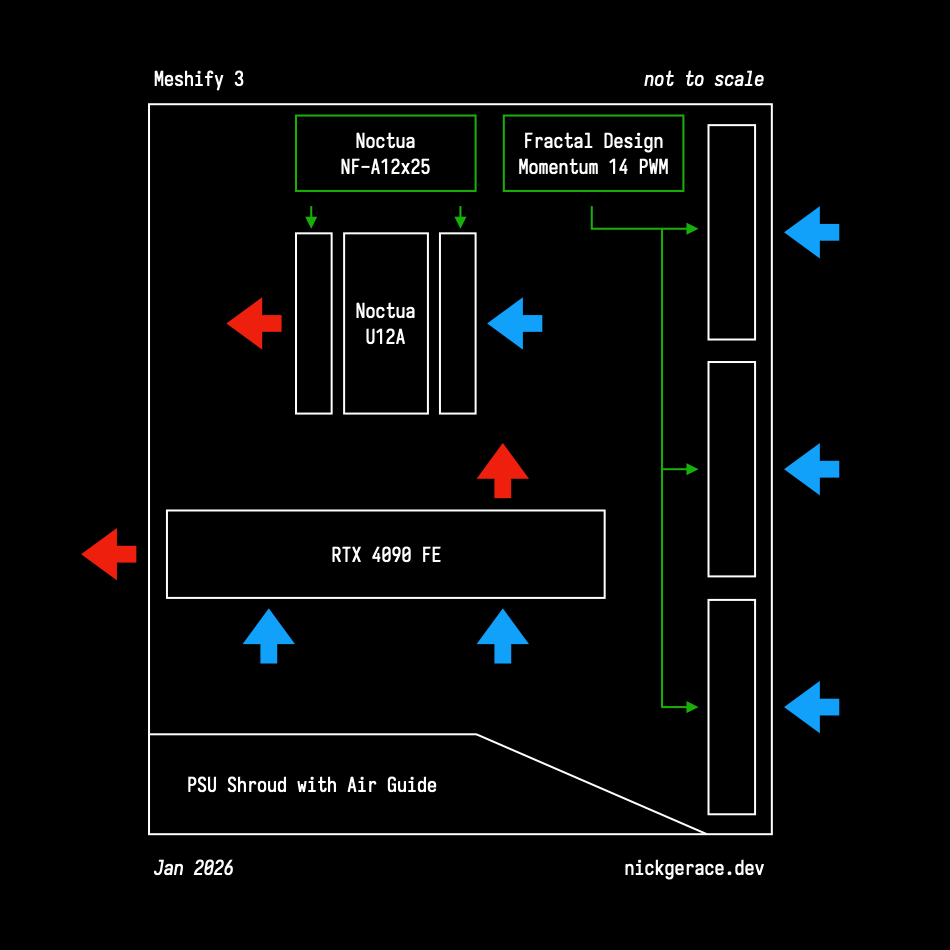
The air guide was a welcome addition to the newest iteration of the Meshify case. It gives the bottom 140mm fan a reason to exist rather than just shooting air into a squared off PSU shroud.
As far as the fan configuration goes, from both my own (questionable) testing and extensive research online, adding a rear exhaust fans and/or two top fans would have had an insignificant performance impact. I didn’t replace the stock fans like I normally would either. I decided to try them and just… haven’t swapped them out because they work well. Sure, if one of them ends up having an issue with a ball-bearing or begins to not work well, I’ll probably swap it out with a Noctua, Phanteks or Arctic fan. For now though, I’ve been impressed with Fractal Design’s Momentum 14 fans.
Overall, if you mix “low-hassle”, “low-number-of-fans”, “low-complexity” and “highly-performant” into a blender, you’ll get my most of… that… build ever! I’m very happy with it! The case is a particular standout. That’s unsurprising given that it won GamersNexus’ “Best Overall Case” for 2025, but it’s still worth mentioning.
The build has been in use since around June 2025 and I do not have any plans to change it in the near future. So, what about the “not-near” future? Ironically, I’ve been eyeing up custom loop builds… the exact opposite of most things I put into that blender. Even more ironically, those are the kinds of builds that work well with the O11D EVO XL given its mechanical design and space for big radiators!
With the great performance and reliability of both of air coolers and AIO liquid coolers these days, why build a custom loop build? I’ve been asking myself that for years, which is why I haven’t done it, but I’ve come to the conclusion custom loop builds are mainly for the artwork, craftsmanship and hands-on fun. The last bit is particularly interesting.
I was listening to Fallthrough episode 53 and the hosts, Matthew and Kris, discussed physical projects they had going on in their lives as well as the cross-functional nature of some of the projects (i.e. things you can tie back to software). I work on software all day, so not only is a physical project a breath of fresh air, but it can also give more exposure to other subjects, sciences, hobbies and communities. I may not end up ever building a custom loop, but its on the radar, perhaps with a component upgrade.
Speaking of “component upgrade”, I doubt I’ll upgrade my CPU without upgrading my GPU. Sure, I may see a benefit by switching to the Ryzen 7 9800X3D (or its rumored refresh SKU), but I’d rather atomically upgrade both parts and experience a bigger uplift. I haven’t upgraded to Nvidia Blackwell (RTX 50 series), AMD Radeon RDNA 4 (RX 9000 series) or Intel Arc Battlemage (BXXX series) for the same reason. Rubin (RTX 60 series) is rumored to be a long way out and there likely won’t be a GPU refresh from Nvidia before then. The ongoing RAM shortage certainly isn’t helping. That being said, there’s a lot of time between now and “2027H2”, so we’ll see.
What I do know is that this current build is bliss! It’s been a blast settling back into a simple, front-to-back “wind tunnel” ATX build.